Most people say I'm a smart guy. Most people think I was born that way and all smart people are born that way. That is never the case, even when people pretend that is true. You are born stupid and only become smart through working at it.
I remember tough neuropsychology tests in college. I was a top student in my class. Like all tests in similar courses (that is, non-math courses), I read the material before class, listened and took notes at every class. A few days before a test I would review the readings and notes and make a set of questions that I thought would appear on the test along with my answers on a stack of index cards or at least some notebook pages. I did not stop studying the cards until I knew them all, often walking around from class to class with a stack of index cards in my hand. (I suspect the best part of my learning was done by my fingers while making the cards. The act of writing, the feel of the cards and their placement in the deck.)
I hated that redheaded female classmate. She would just breeze into to the test and say, "Ah! I had no time to study at all for this! My mother was sick, I've been sick, I've been working so hard and fell asleep at 7 last night and couldn't study." She always had a long sob story to get some attention. She was very self-centered. When the grades came back, hers were about the same as mine - maybe better half the time. She pretended like she was naturally so smart that she could do as well as me - the guy who always had the index cards in his hands.
I was so jealous. Here's a girl who can read the book once and pass the test. There were guys like this in my physics class too. And some nerds in my computer science class seemed to whip out code in an afternoon that took me a week to write.
But all of these stories of natural genius college kids are untrue. They are just trying to build up their own ego while they put yours down. These kids are so smart that they know what's written in a book they never read? Do they live on Mt. Olympus?
The next semester I worked in the same lab as the redhead. Then, as now, I code at all hours so I would often come into the lab at 10PM or 11PM. Guess what I found? The redhead studying her ass off for the test the next day. Papers and scribbled everywhere. The first time I saw this she instantly knew she her secret was uncovered and her cheeks became as red as her hair.
The nerdy programmers? Later I found out that their rich parents had gotten them a $3,500 computer and programming courses starting 4 years before college. They shouldn't have even taken the course they should have taken harder courses to challenge themselves and grow, but slacked and took an ego-boost review class instead and shoved it in every rookie coder's face.
Like most smart people, I thought I was stupid and I needed to take every step and use every minute to catch up to everyone and pretend like I'm a smart person. This is the Imposter Syndrome that achieving individuals share. To me, it was born from a paranoia, a fear of failure, and a willingness to succeed. I don't think of this as bad, hard to live with sometimes, but it is the grindstone that sharpens the sword of your mind and helps you succeed.
The difference between natural and acquired learning was made clear to me when I applied for graduate school and took the standard GRE test, similar to the SAT. I scored around 600 out of 800 on my verbal SAT n high school, without study, but scored 780 on my verbal GRE - which is much harder - by using an enormous stack of cards. Was I naturally 45% smarter because of my tremendous natural brain growth from 18-22? Of course not. I always had the potential to be smart but I needed to work at it to reach my potential.
Women like to turn this universal syndrome into sexism - and as soon as they do, then sexism exists in their minds and it is very effective. They don't even need a man in town to be sexist to them. Sexism can exist in a vaccuum of 1. It's the same with racism. Sexism and racism exist, but much more within us than outside of us. Provincialism, language-ism, religion-ism, whatever, they mostly hold you back only if you let them.
Friday, April 29, 2016


Thursday, February 11, 2016
Recognizing out Violence, the Forward to Nonviolent Communication by Arun Ghandi
Mahatma Ghandi's grandson, Arun Gandhi, wrote a Forward to "Nonviolent Communication" that is so great, my good friend Karen Wagner recommended Marshall B Rosenberg's book to me 5 years ago and I still haven't gotten past the Forward (and I really need to!). I think it says a lot of things about the world at large and our politics now and our personal and social lives, and that has been true every time I've read it.
I'm changing, will you? If we all change, we'll all change faster for the better.
Forward to Nonviolent Communication Marshall B Rosenberg's By Arun Gandhi
As a person of color, growing up in apartheid South Africa in the 1940 was not something anyone relished. Especially if you were brutally reminded of your skin color every moment of every day. To be beaten up at the age of ten by white youths because they consider you to be too black and then by black youths because they consider you too white is a humiliating experience that would drive anyone to vengeful violence.
I was so outraged that my parents decided to take me to India and leave me for some time with Grandfather, the legendary M.K. Gandhi, so that I could learn from him how to deal with the anger, the frustration, the discrimination, and the humiliation that violence color prejudice can invoke in you. In the eighteen months I learned more than anticipated. My only regret now is that I was just thirteen years old and a mediocre student at that. If only I had been older, a but wiser, and a bit more thoughtful, I could have learned so much more. But, one must be happy with what one has received and not be greedy, a fundamental lesson in nonviolent living. How can I forget this?
One of the many things I learned from Grandfather is to understand the depth and breadth of nonviolence and to acknowledge that one is violent and that one needs to bring about a qualitative change in one's attitude. We often don't acknowledge our violence because we are ignorant about it; we assume we are not violent because our vision of violence is one of fighting, killing, beating, and wars - the types of things that average individuals don't do.
To bring this home to me, grandfather made me draw a family tree of violence using the same principles as are used for a genealogical tree. His argument was that I would have a better appreciation of nonviolence if I understood and acknowledged the violence that exists in the world. He assisted me every evening to analyze the day’s happenings—everything that I experienced, read about, saw or did to others—and put them down on the tree either under “physical” (if it was violence where physical force was used) or under “passive” (if it was the type of violence where the hurt was more emotional).
Within a few months I covered one wall in my room with acts of “passive" violence that grandfather described as being more insidious than “physical" violence. He then explained that passive violence ultimately generated anger in the victim who, as an individual or as a member of a collective, responded violently. In other words it is passive violence that fuels the fire of physical violence. It is because we don’t understand or appreciate this concept that all our efforts to work for peace have either not fructified, or the peace that we achieved was only temporary. How can we extinguish a fire if we don’t first cut off the fuel that ignites the inferno?
Unless, as he would say, “we become the change we wish to see in the world,” no change will ever take place. We are all, unfortunately, waiting for the other person to change first.
I'm changing, will you? If we all change, we'll all change faster for the better.
Forward to Nonviolent Communication Marshall B Rosenberg's By Arun Gandhi
As a person of color, growing up in apartheid South Africa in the 1940 was not something anyone relished. Especially if you were brutally reminded of your skin color every moment of every day. To be beaten up at the age of ten by white youths because they consider you to be too black and then by black youths because they consider you too white is a humiliating experience that would drive anyone to vengeful violence.
I was so outraged that my parents decided to take me to India and leave me for some time with Grandfather, the legendary M.K. Gandhi, so that I could learn from him how to deal with the anger, the frustration, the discrimination, and the humiliation that violence color prejudice can invoke in you. In the eighteen months I learned more than anticipated. My only regret now is that I was just thirteen years old and a mediocre student at that. If only I had been older, a but wiser, and a bit more thoughtful, I could have learned so much more. But, one must be happy with what one has received and not be greedy, a fundamental lesson in nonviolent living. How can I forget this?
One of the many things I learned from Grandfather is to understand the depth and breadth of nonviolence and to acknowledge that one is violent and that one needs to bring about a qualitative change in one's attitude. We often don't acknowledge our violence because we are ignorant about it; we assume we are not violent because our vision of violence is one of fighting, killing, beating, and wars - the types of things that average individuals don't do.
To bring this home to me, grandfather made me draw a family tree of violence using the same principles as are used for a genealogical tree. His argument was that I would have a better appreciation of nonviolence if I understood and acknowledged the violence that exists in the world. He assisted me every evening to analyze the day’s happenings—everything that I experienced, read about, saw or did to others—and put them down on the tree either under “physical” (if it was violence where physical force was used) or under “passive” (if it was the type of violence where the hurt was more emotional).
Within a few months I covered one wall in my room with acts of “passive" violence that grandfather described as being more insidious than “physical" violence. He then explained that passive violence ultimately generated anger in the victim who, as an individual or as a member of a collective, responded violently. In other words it is passive violence that fuels the fire of physical violence. It is because we don’t understand or appreciate this concept that all our efforts to work for peace have either not fructified, or the peace that we achieved was only temporary. How can we extinguish a fire if we don’t first cut off the fuel that ignites the inferno?
Unless, as he would say, “we become the change we wish to see in the world,” no change will ever take place. We are all, unfortunately, waiting for the other person to change first.
Sunday, November 8, 2015
Reduplication
The golf course in Mandaluyong, Manila is called the Whack-Whack Golf Course.
I think this is an example of a feature of many Asian languages called Full Reduplication. All the Filipino languages have it (kàon-káon "eat-eat"; hìbî-híbî "cry-cry"; tinlò-tinlò "clean-clean" are examples in Hiliganon (often, though mistakenly called "Illongo"). A motorcycle cab with a sidecar is called a "tuk-tuk" in many Asian countries. You can hear Japanese and Thais say "same-same" when speaking English, I assume this comes from their root of the word "same", and is typical of how reduplication is used - for emphasis. Wikipedia is a wiki, and all wiki's get their name from the Hawaiian "wiki-wiki", which means quick, really quick!
I don't think Mandarin has reduplication, except for kinship (叔叔 shūshu - uncle who is younger than after and 伯伯 bóbo for an uncle who is older) but I could easily be wrong. The Italian for "take it easy" is "piano-piano" (softly, softly).
There are other kinds of reduplication such as partial reduplication ("tick-tock" ) and rhyming reduplication ("dazzle-dazzle", hanky-panky"), baby reduplication (mama, papa, baba), and onomatopoeia reduplication ("bow-wow"). Except for "bye-bye", which could be characterized as baby reduplication, I can't think of an English full reduplication. I'm not sure if "knock-knock" counts since it's from knock-knock jokes which themselves come from the passwords needed when gaining access to a hidden speakeasy bar during alcohol prohibition in the 1930s.
"Whack Whack" sounds funny to Americans, like it should be a mini-golf course, mostly because it sounds like baby talk. Similarly "same-same" sounds funny to Filipinos. It seems all legit when put into language context.
https://en.m.wikipedia.org/wiki/Reduplication
Saturday, December 13, 2014
2015 U.S. Mobile Phone Plans (hint: Rok Mobile)
My friends have been recommending MVNO's to me. These mobile phone service providers use the same networks as the national carriers and offer many interesting inexpensive plans, some even free. There are so many that it's clear that most people have a far better alternative with an MVNO like Ting than directly with the mobile phone network owners (Verizon, ATT, Sprint, TMobile). I used WhistleOut for much of my initial research, but I've visited and investigated most of the plans on nearly all the MVNOs (I think) and all the major carriers sites so I thought I'd report back on what I've found.
I've been a Sprint subscriber since the 1990's since they've always been the best value. They may still be the best value for many, but I'm finally ditching them. I'm a techie and a data hog, though I don't watch a lot of video, which is where the vast majority of data usage lies, but when I need my data, I need it. Sprint never throttled my data, even after using the hotspot regularly. They didn't have a hotspot charge until a few years ago ($10 extra), but when the new owners took over they started to throttle at 3GB and the hotspot charge went to $30. At that point, it wasn't the best value for me anymore. I've had an iPhone 5S on Sprint.
I've been all over the Boston area this year and have been using OpenSignal app and my They turned on their new network 4G LTE network in Boston about a year ago only (after the WiMAX flameout), and only now as they still build it out during the year, am I starting to see a difference. I bought an iPhone 6S and tried AT&T for a month and it's 4G LTE seemed to be available everywhere and far speedier than Sprint's, so I wouldn't mind a network change (though when I'm near one of Sprint's new towers, Sprint is faster). I have had a Verizon mobile hotspot and they seem to 15% more widely available than Sprint's and usually faster as well, though not as fast as AT&T's.
Overall network coverage is converging and price is becoming the differentiator, and MVNOs have greatly increased the competition, thanks to Obama's FCC. Since they are using the same networks, and are very cheap, why not switch?
I'd like to save a lot on the outrageous sums I've paid to Sprint over the years. I want to avoid having to count my bytes and I also prefer a known bill rather than worry about if I should call someone or whether I was roaming when I watched that video for fear of a charge worth about a full month's bill. I text some, but don't talk a lot, but talk is cheap, literally, so the plans that fit me best are the unlimited plans and that's where I focused my research. At the same time, I have a second number I'd like to keep as cheaply as possible as I can, so I kept my eye on that too. Unlimited data plans are easy to come by, what you pay for nowadays is the 4G speed over the 3G (or slower) speeds. Most providers will give you a limited amount at 4G speeds, which I'd say are about 4 times faster experientially, and then the rest of your data at 3G is pretty cheap to come by.
RepublicWireless has an interesting $5/month wifi-only plan which can be quite economical in many circumstances. For the unlimited lovers, unlimited talk, text and data (over cell), and unlimited data, throttled after 5GB for $40. However, it's not really unlimited since it's stopped, not throttled, if you violate the 5GB a second time in 6 months, and there doesn't seem to be tethering support.
Boost mobile has $45 unlimited 4G, but no hotspot. The might be the best deal if our winner wasn't running a special.
Rok Mobile has nearly the best unlimited deal, with a current offer that beats everything. First, Rox Mobile was started by the same man who started Patron tequila, enough said! (And Paul Mitchell hair products, both great companies with high quality products). Rok Mobile has unlimited talk, text (including international) and web with 5GB at 4G LTE for $49.99 - with 4 months free, that's like $33/month! Plus it adds some nice added bonuses, especially a "free" subscription to their Rox Music service with unlimited music streaming and none of it counting against your download data. Additionally you get and access to 20 million wifi hotspots. The downside? No hotspot! Still, that's a great deal no matter how you look at it, it beats almost all MVNO 2GB of 4G plans.
"With Tethering" Category
MetroPCS (TMobile Network) has the best really unlimited plan, unlimited talk, text and supposedly unlimited 4G LTE all month, no throttles, for $60, $65 to use it with a hotspot tethering. This is $80 a month from TMobile directly.
I've been a Sprint subscriber since the 1990's since they've always been the best value. They may still be the best value for many, but I'm finally ditching them. I'm a techie and a data hog, though I don't watch a lot of video, which is where the vast majority of data usage lies, but when I need my data, I need it. Sprint never throttled my data, even after using the hotspot regularly. They didn't have a hotspot charge until a few years ago ($10 extra), but when the new owners took over they started to throttle at 3GB and the hotspot charge went to $30. At that point, it wasn't the best value for me anymore. I've had an iPhone 5S on Sprint.
I've been all over the Boston area this year and have been using OpenSignal app and my They turned on their new network 4G LTE network in Boston about a year ago only (after the WiMAX flameout), and only now as they still build it out during the year, am I starting to see a difference. I bought an iPhone 6S and tried AT&T for a month and it's 4G LTE seemed to be available everywhere and far speedier than Sprint's, so I wouldn't mind a network change (though when I'm near one of Sprint's new towers, Sprint is faster). I have had a Verizon mobile hotspot and they seem to 15% more widely available than Sprint's and usually faster as well, though not as fast as AT&T's.
Overall network coverage is converging and price is becoming the differentiator, and MVNOs have greatly increased the competition, thanks to Obama's FCC. Since they are using the same networks, and are very cheap, why not switch?
I'd like to save a lot on the outrageous sums I've paid to Sprint over the years. I want to avoid having to count my bytes and I also prefer a known bill rather than worry about if I should call someone or whether I was roaming when I watched that video for fear of a charge worth about a full month's bill. I text some, but don't talk a lot, but talk is cheap, literally, so the plans that fit me best are the unlimited plans and that's where I focused my research. At the same time, I have a second number I'd like to keep as cheaply as possible as I can, so I kept my eye on that too. Unlimited data plans are easy to come by, what you pay for nowadays is the 4G speed over the 3G (or slower) speeds. Most providers will give you a limited amount at 4G speeds, which I'd say are about 4 times faster experientially, and then the rest of your data at 3G is pretty cheap to come by.
Findings
Honerable Mentions
Ting may be the service best plan for users that don't want a lot of data, especially for people who can use wifi most of the time, but their mobile data gets expensive. A plan with just 100 minutes of talk (about all I need), 1000 texts with 1 phone is just $14. Add in 2GB of data - I minimally am like the rest of us and use 1-2GB a month (until I tether), then the bill jumps to $43, which doesn't beat Sprints $50 unlimited plan. Anyway my iPhone 5S won't be Ting-ready until they turn their new GSM network online in February.Runner Ups
RingPlus beats Ting hands-down, with $33 for unlimited talk, unlimited global SMS and 2.5 GB of data. Additionally, RingPlus, like many of these new MVNO services, has unlimited calling via wifi as well, if you happen to have wifi and bad phone service (often true indoors).RepublicWireless has an interesting $5/month wifi-only plan which can be quite economical in many circumstances. For the unlimited lovers, unlimited talk, text and data (over cell), and unlimited data, throttled after 5GB for $40. However, it's not really unlimited since it's stopped, not throttled, if you violate the 5GB a second time in 6 months, and there doesn't seem to be tethering support.
Boost mobile has $45 unlimited 4G, but no hotspot. The might be the best deal if our winner wasn't running a special.
Winners
"Without Tethering" CategoryRok Mobile has nearly the best unlimited deal, with a current offer that beats everything. First, Rox Mobile was started by the same man who started Patron tequila, enough said! (And Paul Mitchell hair products, both great companies with high quality products). Rok Mobile has unlimited talk, text (including international) and web with 5GB at 4G LTE for $49.99 - with 4 months free, that's like $33/month! Plus it adds some nice added bonuses, especially a "free" subscription to their Rox Music service with unlimited music streaming and none of it counting against your download data. Additionally you get and access to 20 million wifi hotspots. The downside? No hotspot! Still, that's a great deal no matter how you look at it, it beats almost all MVNO 2GB of 4G plans.
"With Tethering" Category
MetroPCS (TMobile Network) has the best really unlimited plan, unlimited talk, text and supposedly unlimited 4G LTE all month, no throttles, for $60, $65 to use it with a hotspot tethering. This is $80 a month from TMobile directly.
Google Chrome and Chrome OS could Be Huge
The move to an all-Cloud life is curving upwards. Most people have wifi most of the time they crack open their computers and mobile broadband hotspots are getting nearly cheap (more in my next post). Maybe we don't have to carry powerful laptops anymore?
In order to work with the high school class I help teach, I bought a Chromebook to match what the students have. I bought the best one out there and it was just $239 (in store is cheaper), many Chromebooks can be had for around $120. The specs are light in some ways, a 14" screen (1366x768), 2GB RAM, 16GB Hard drive (not a misprint), but it is made for connectivity and mobility: 1 HDMI port, 3 USBs ports (one is 3.0), SD slot, 802.11ac wifi, bluetooth, camera, a nearly 3000 mAh battery which seems to last forever (they always do at first, don't they?), and it comes with 1TB of Google Drive storage for two years for free - ah, there's the real hard drive. I do wish Google Drive was versioned content management, like Time Machine, but I can't even see old revisions of Google-originated documents, maybe I'm missing something.
I used the machine for only a few days, but it's clear that I can do nearly all of what I need to do on it, and I like the keyboard navigation better on it than a Mac. With my Mac crashing almost as much as Win98 now, and Macs being WICKED expensive, I have to consider if I could replace it for a mere $250 (with resale values on Macs seemingly near 95%). The Chromebook is about 10% lighter than my MacBook Pro 15", so I don't mind being lighter in the hand as well as the wallet.
When I moved to the Mac from Windows I moved everything to the cloud - a lot of that was moving things to Google Drive, much of it what have been great online services - Evernote, ToDoPro, Mint, and all the mobile apps and websites I use. I've already learned that machines come and go, but your data is always your data, so keep everything near permanent backed up to external hard drives (except my Google data, which I should do). The idea was to create OS independence, so I could move to - and away from - the Mac easily. Could I move to Chrome OS?
After 6 years, 3 Macs (one a used starter, one run over after 5 years - they do last, one recent replacement) and 3 iPhones (4S, 5S, 6Plus), I am still not very tied to MacOS/iOS. I am somewhat tied to Aperture (sort of, you can get at the pics underneath their database easy enough) but the only real major tie to is TimeMachine - one of the main reasons I moved to Mac in the first place. Since I have a lot of data backed up on Time Machine, I'll always need a Mac around, or a Virtual Machine for a MacOS, and I will always have that around. Heck I could always have a virtual machine for OS/2!
It's not just me, most people are far less tied to OS's now that we are all using apps in the cloud. In fact, maybe people are more tied to Google's main services than the various operating system they are using on their various devices. In the meantime, Chrome has recently become the majority browser. It's been a long war, but Chrome is winning and none of the competitors can recapture share (Microsoft and Opera certainly won't, Safari can only change as far as their OS penetration, and no further, and Firefox is improving but it will be hard to keep up without the same level of funding).
Chrome is now invading other OS's desktops. After adding a Chrome Extension, I automatically got this helpful new Google portal on my Mac dock, just like the one on my Chromebook's start menu.

Ah, so I can use all those apps that plug into Chrome on all my devices? Nice. I don't think it's hard to see Google growing their eyeshare from here.
But I'm a developer! How could I get along on a Chromebook? The time for development to move to the cloud is near, maybe not here, but near.
We almost had cloud-like development in the 1990's with ClearCase - a virtual file system, very similar to Google Drive, but with controllable versioning, like Time Machine (on steroids). It could never quite work because the files a developer edits were always local because the developer tools were always local so it was very slow as the compiler reached across the network to find the net file, 10,000 times. I can here some of my old IBM mainframe friends that they were developing in the cloud, and it's true, though the cloud was usually in the building.
In 2015, developers have many tools living in the cloud - editors, compilers, builders, test runners, test and production machines. They seem mature enough for Javascript development, though the tools for Java may be somewhat behind. (I'm trying out Cloud9, no review ready yet.) All we need now is a little terminal. Ah, but ChromeOS has bash and if that's not good enough, maybe Ubuntu on a Chromebook would work!
Wednesday, March 20, 2013
Jack-a-Roe & Women Warriors
I went to the tailor shop today (as an aside run by a wonderful elder Italian gentleman, Joe Giullo, Rte. 9 Shrewsbury, near The Bean Counter). Of course the rest of the day I was singing (and playing) "I went down to the tailor shop to dress in men's array..." from Jack-a-Roe, a traditional song that the Grateful Dead kept alive for millions. A particularly interesting version can be heard here.
The lyrics are very dense - a wealthy merchant's daughter is courted by many, but Jack-a-Roe, a sailor, was her true love. He left to sail in a war so she went down to the tailor's shop to dress in men's clothing and snuck aboard a boat as a man. After the war, she found her true love wounded, got a doctor to heal his wounds, and they got married.
As I often want to do with traditional songs, I looked up the history.
Here's the original ballad, posted as a bill, between 1774 and 1825, as a war protest.

Jack Munro ("In Chatham town there liv'd a worthy merchant man ...")
The theme of the woman warrior is not unique to the West, of course. A similar ballad around 400 AD inspired Mulan.
The lyrics are very dense - a wealthy merchant's daughter is courted by many, but Jack-a-Roe, a sailor, was her true love. He left to sail in a war so she went down to the tailor's shop to dress in men's clothing and snuck aboard a boat as a man. After the war, she found her true love wounded, got a doctor to heal his wounds, and they got married.
As I often want to do with traditional songs, I looked up the history.
Jack-A-Roe also occurs as Jackaroe or Jackaro. It is one of a number of closely related songs that also occur as Jack Monroe, Jack Munro, Jack The Sailor and The Love of Polly and Jack Monroe, possibly also as Jackie Frazer. Possibly the earliest recorded version of a similar song is titled Jack Munro and is held in the ballad collection of the Bodleian Library at the University of Oxford. This dates from roughly around 1800.
Here's the original ballad, posted as a bill, between 1774 and 1825, as a war protest.

Jack Munro ("In Chatham town there liv'd a worthy merchant man ...")
The theme of the woman warrior is not unique to the West, of course. A similar ballad around 400 AD inspired Mulan.
Friday, July 9, 2010
Robtos: Trust me, I'll get you a beer!
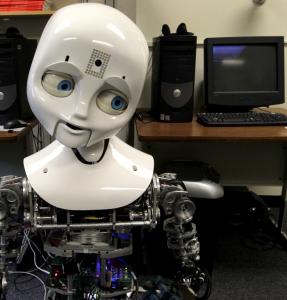
Robots are becoming useful now that engineers are realizing it's all about the human interaction.
Summary of the Boston Globe article from the ACM News:
Robot May Furnish Lesson in Human Trust
Boston Globe (07/05/10) Johnson, Carolyn Y.
Boston-area scientists are using a new robot to study the signals that people use to decide whether to trust one another within minutes of meeting. "There should be some signal for trustworthiness that's subtle and hard to find, but [it is] there," says Northeastern University's David DeSteno. The robot, called Nexi, has advantages over human participants because people use subtle gestures, or engage in unintentional mimicry, that can be hard to measure or control. Nexi has many human expressions, but researchers can control every aspect of its behavior, which enables them to test what nonverbal cues might seem more or less trustworthy. The research also could help roboticists find ways to design machines that will be trusted partners for humans. The experiment is a collaboration between the Massachusetts Institute of Technology, Northeastern, and Cornell University. At the end of the experiment, researchers measured how trustworthy the participants found Nexi to be using an economic task in which they decided how many tokens to exchange with Nexi and predicted how many tokens Nexi would give them.
If that creeps you out too much, maybe just try having your computer to get you a beer.

Subscribe to:
Posts (Atom)