Saturday, December 13, 2014

2015 U.S. Mobile Phone Plans (hint: Rok Mobile)

My friends have been recommending MVNO's to me.  These mobile phone service providers use the same networks as the national carriers and offer many interesting inexpensive plans, some even free.  There are so many that it's clear that most people have a far better alternative with an MVNO like Ting than directly with the mobile phone network owners (Verizon, ATT, Sprint, TMobile).  I used WhistleOut for much of my initial research, but I've visited and investigated most of the plans on nearly all the MVNOs (I think) and all the major carriers sites so I thought I'd report back on what I've found.

I've been a Sprint subscriber since the 1990's since they've always been the best value.  They may still be the best value for many, but I'm finally ditching them.  I'm a techie and a data hog, though I don't watch a lot of video, which is where the vast majority of data usage lies, but when I need my data, I need it.  Sprint never throttled my data, even after using the hotspot regularly.  They didn't have a hotspot charge until a few years ago ($10 extra), but when the new owners took over they started to throttle at 3GB and the hotspot charge went to $30. At that point, it wasn't the best value for me anymore.  I've had an iPhone 5S on Sprint.

I've been all over the Boston area this year and have been using OpenSignal app and my They turned on their new network 4G LTE network in Boston about a year ago only (after the WiMAX flameout), and only now as they still build it out during the year, am I starting to see a difference.  I bought an iPhone 6S and tried AT&T for a month and it's 4G LTE seemed to be available everywhere and far speedier than Sprint's, so I wouldn't mind a network change (though when I'm near one of Sprint's new towers, Sprint is faster). I have had a Verizon mobile hotspot and they seem to 15% more widely available than Sprint's and usually faster as well, though not as fast as AT&T's.

Overall network coverage is converging and price is becoming the differentiator, and MVNOs have greatly increased the competition, thanks to Obama's FCC.  Since they are using the same networks, and are very cheap, why not switch?

I'd like to save a lot on the outrageous sums I've paid to Sprint over the years.  I want to avoid having to count my bytes and I also prefer a known bill rather than worry about if I should call someone or whether I was roaming when I watched that video for fear of a charge worth about a full month's bill. I text some, but don't talk a lot, but talk is cheap, literally, so the plans that fit me best are the unlimited plans and that's where I focused my research.  At the same time, I have a second number I'd like to keep as cheaply as possible as I can, so I kept my eye on that too.  Unlimited data plans are easy to come by, what you pay for nowadays is the 4G speed over the 3G (or slower) speeds.  Most providers will give you a limited amount at 4G speeds, which I'd say are about 4 times faster experientially, and then the rest of your data at 3G is pretty cheap to come by.

Findings

Honerable Mentions

Ting may be the service best plan for users that don't want a lot of data, especially for people who can use wifi most of the time, but their mobile data gets expensive.  A plan with just 100 minutes of talk (about all I need), 1000 texts with 1 phone is just $14.  Add in 2GB of data - I minimally am like the rest of us and use 1-2GB a month (until I tether), then the bill jumps to $43, which doesn't beat Sprints $50 unlimited plan.  Anyway my iPhone 5S won't be Ting-ready until they turn their new GSM network online in February.

Runner Ups

RingPlus beats Ting hands-down, with $33 for unlimited talk, unlimited global SMS and 2.5 GB of data.  Additionally, RingPlus, like many of these new MVNO services, has unlimited calling via wifi as well, if you happen to have wifi and bad phone service (often true indoors).

RepublicWireless has an interesting $5/month wifi-only plan which can be quite economical in many circumstances.  For the unlimited lovers, unlimited talk, text and data (over cell), and unlimited data, throttled after 5GB for $40.  However, it's not really unlimited since it's stopped, not throttled, if you violate the 5GB a second time in 6 months, and there doesn't seem to be tethering support.

Boost mobile has $45 unlimited 4G, but no hotspot.  The might be the best deal if our winner wasn't running a special.

Winners

"Without Tethering" Category
Rok Mobile has nearly the best unlimited deal, with a current offer that beats everything.  First, Rox Mobile was started by the same man who started Patron tequila, enough said! (And Paul Mitchell hair products, both great companies with high quality products). Rok Mobile has unlimited talk, text (including international) and web with 5GB at 4G LTE for $49.99 - with 4 months free, that's like $33/month!  Plus it adds some nice added bonuses, especially a "free" subscription to their Rox Music service with unlimited music streaming and none of it counting against your download data.  Additionally you get and access to 20 million wifi hotspots. The downside?  No hotspot!  Still, that's a great deal no matter how you look at it, it beats almost all MVNO 2GB of 4G plans.

"With Tethering" Category
MetroPCS (TMobile Network) has the best really unlimited plan, unlimited talk, text and supposedly unlimited 4G LTE all month, no throttles, for $60, $65 to use it with a hotspot tethering.  This is $80 a month from TMobile directly.

Google Chrome and Chrome OS could Be Huge


The move to an all-Cloud life is curving upwards. Most people have wifi most of the time they crack open their computers and mobile broadband hotspots are getting nearly cheap (more in my next post). Maybe we don't have to carry powerful laptops anymore?

In order to work with the high school class I help teach, I bought a Chromebook to match what the students have. I bought the best one out there and it was just $239 (in store is cheaper), many Chromebooks can be had for around $120. The specs are light in some ways, a 14" screen (1366x768), 2GB RAM, 16GB Hard drive (not a misprint), but it is made for connectivity and mobility: 1 HDMI port, 3 USBs ports (one is 3.0), SD slot, 802.11ac wifi, bluetooth, camera, a nearly 3000 mAh battery which seems to last forever (they always do at first, don't they?), and it comes with 1TB of Google Drive storage for two years for free - ah, there's the real hard drive. I do wish Google Drive was versioned content management, like Time Machine, but I can't even see old revisions of Google-originated documents, maybe I'm missing something.

I used the machine for only a few days, but it's clear that I can do nearly all of what I need to do on it, and I like the keyboard navigation better on it than a Mac. With my Mac crashing almost as much as Win98 now, and Macs being WICKED expensive, I have to consider if I could replace it for a mere $250 (with resale values on Macs seemingly near 95%). The Chromebook is about 10% lighter than my MacBook Pro 15", so I don't mind being lighter in the hand as well as the wallet.

When I moved to the Mac from Windows I moved everything to the cloud - a lot of that was moving things to Google Drive, much of it what have been great online services - Evernote, ToDoPro, Mint, and all the mobile apps and websites I use. I've already learned that machines come and go, but your data is always your data, so keep everything near permanent backed up to external hard drives  (except my Google data, which I should do). The idea was to create OS independence, so I could move to - and away from - the Mac easily.  Could I move to Chrome OS?

After 6 years, 3 Macs (one a used starter, one run over after 5 years - they do last, one recent replacement) and 3 iPhones (4S, 5S, 6Plus), I am still not very tied to MacOS/iOS. I am somewhat tied to Aperture (sort of, you can get at the pics underneath their database easy enough) but the only real major tie to is TimeMachine - one of the main reasons I moved to Mac in the first place. Since I have a lot of data backed up on Time Machine, I'll always need a Mac around, or a Virtual Machine for a MacOS, and I will always have that around. Heck I could always have a virtual machine for OS/2!

It's not just me, most people are far less tied to OS's now that we are all using apps in the cloud. In fact, maybe people are more tied to Google's main services than the various operating system they are using on their various devices. In the meantime, Chrome has recently become the majority browser. It's been a long war, but Chrome is winning and none of the competitors can recapture share (Microsoft and Opera certainly won't, Safari can only change as far as their OS penetration, and no further, and Firefox is improving but it will be hard to keep up without the same level of funding).

Chrome is now invading other OS's desktops.  After adding a Chrome Extension, I automatically got this helpful new Google portal on my Mac dock, just like the one on my Chromebook's start menu.

Ah, so I can use all those apps that plug into Chrome on all my devices? Nice. I don't think it's hard to see Google growing their eyeshare from here.

But I'm a developer! How could I get along on a Chromebook? The time for development to move to the cloud is near, maybe not here, but near.

We almost had cloud-like development in the 1990's with ClearCase - a virtual file system, very similar to Google Drive, but with controllable versioning, like Time Machine (on steroids). It could never quite work because the files a developer edits were always local because the developer tools were always local so it was very slow as the compiler reached across the network to find the net file, 10,000 times. I can here some of my old IBM mainframe friends that they were developing in the cloud, and it's true, though the cloud was usually in the building.

In 2015, developers have many tools living in the cloud - editors, compilers, builders, test runners, test and production machines. They seem mature enough for Javascript development, though the tools for Java may be somewhat behind. (I'm trying out Cloud9, no review ready yet.)  All we need now is a little terminal. Ah, but ChromeOS has bash and if that's not good enough, maybe Ubuntu on a Chromebook would work!


Wednesday, March 20, 2013

Jack-a-Roe & Women Warriors

I went to the tailor shop today (as an aside run by a wonderful elder Italian gentleman, Joe Giullo, Rte. 9 Shrewsbury, near The Bean Counter).  Of course the rest of the day I was singing (and playing) "I went down to the tailor shop to dress in men's array..." from Jack-a-Roe, a traditional song that the Grateful Dead kept alive for millions.  A particularly interesting version can be heard here.

The lyrics are very dense - a wealthy merchant's daughter is courted by many, but Jack-a-Roe, a sailor, was her true love.  He left to sail in a war so she went down to the tailor's shop to dress in men's clothing and snuck aboard a boat as a man.  After the war, she found her true love wounded, got a doctor to heal his wounds, and they got married.

As I often want to do with traditional songs, I looked up the history.
Jack-A-Roe also occurs as Jackaroe or Jackaro. It is one of a number of closely related songs that also occur as Jack Monroe, Jack Munro, Jack The Sailor and The Love of Polly and Jack Monroe, possibly also as Jackie Frazer. Possibly the earliest recorded version of a similar song is titled Jack Munro and is held in the ballad collection of the Bodleian Library at the University of Oxford. This dates from roughly around 1800.

Here's the original ballad, posted as a bill, between 1774 and 1825, as a war protest.

Jack Munro ("In Chatham town there liv'd a worthy merchant man ...") 

The theme of the woman warrior is not unique to the West, of course.  A similar ballad around 400 AD  inspired Mulan.

Friday, July 9, 2010

Robtos: Trust me, I'll get you a beer!


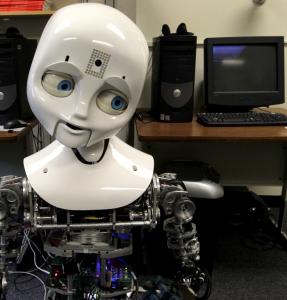
Robots are becoming useful now that engineers are realizing it's all about the human interaction.


Summary of the Boston Globe article from the ACM News:
Robot May Furnish Lesson in Human Trust
Boston Globe (07/05/10) Johnson, Carolyn Y.

Boston-area scientists are using a new robot to study the signals that people use to decide whether to trust one another within minutes of meeting. "There should be some signal for trustworthiness that's subtle and hard to find, but [it is] there," says Northeastern University's David DeSteno. The robot, called Nexi, has advantages over human participants because people use subtle gestures, or engage in unintentional mimicry, that can be hard to measure or control. Nexi has many human expressions, but researchers can control every aspect of its behavior, which enables them to test what nonverbal cues might seem more or less trustworthy. The research also could help roboticists find ways to design machines that will be trusted partners for humans. The experiment is a collaboration between the Massachusetts Institute of Technology, Northeastern, and Cornell University. At the end of the experiment, researchers measured how trustworthy the participants found Nexi to be using an economic task in which they decided how many tokens to exchange with Nexi and predicted how many tokens Nexi would give them.

If that creeps you out too much, maybe just try having your computer to get you a beer.

Monday, July 5, 2010

The Real "Avatar" (The Last Airbender)

I saw The Last Airbender this weekend with my 13 year old and his friends. If you don't know, the movie is based on the cartoon called Avatar : The Last Airbender. I call it the "real" Avatar because Avatar the blockbuster movie hardly reflects the meaning of the word. The word "Avatar" comes from the Sanskrit word for "descent," meaning a spirit (or "God"), descending to the material world as a human. You may think such a notion is preposterous, or you may have deep faith that some Avatar is your personal savior (like Jesus Christ or Krishna), but in either case, an Avatar, fictional or factual, is more closely related to the Last Airbender than the Marine in the virtual blue suit.

As you might expect, I enjoyed The Last Airbender more than Avatar. Avatar was three hours of over-the-top drama. The Last Airbender was far more subtle. Instead of yelling and screaming and in-your-face interaction, Aang, the main character's strongest imperative was telling an animal "Be nice."

Noah Ringer, who played Aang, was phenomenal. I was expecting to be disappointed, as most were by Hayden Christenson playing the adult Anakin Skywalker. Monks with power are very difficult to play, but Ringer did what great actors Ewan MacGregor and Liam Neeson could not pull off - maintain a constant state of grace and even temper while exercising power in difficult circumstances (Alec Guinness, the original Obi-Wan Kenobi, maintained grace, but his style was better suited for stage than film).

The theatergoers, including my triad of 13 year olds, did not like the movie. They picked on the things missing from the cartoon, like the villian's missing ponytail or the fact that Aang was pronounced more properly like a mantra than like it was in the cartoon (rhymed with "hang"). After comparing Aang to the Jedi, I was met with disbelief by the 13 year olds. "Aang is not a monk - he's a warrior!" That led to a 15 minute diatribe about the Bhagavad Gita's ("What? What do you mean we've never heard of the most widely read book ever?!") Arjuna the Archer, Joseph Campbell's Hero with a Thousand Faces, and Star Wars. I think I got enough into their minds that it will spark their interest when they come across it again sometime.

China's Government Advocates for Workers

According to this IBD story, "Chinese workers are usually represented by government-sponsored unions. "

Now I suspect this may not be all it's cracked up to be since "Many recent labor disturbances were organized outside these communist-backed groups." But still can you just imagine a government advocating on behalf of workers? I suppose if you remember America in the 1930's or 1940's, you might remember, but in my lifetime, government has been 98% a tool of business interests - the capitalists - not labor. I know there was once or twice a raise in the minimum wage (fat chance of that happening again now that Ted Kennedy is dead). And I am well aware that those who rely on FOX News for their worldview think labor and teachers have an undue influence on government, but just that fact that the notion that the government advocates for labor is a foreign idea to most Americans (and anathema to many) shows how tilted the power in this democracy has become. Some say America is now Fascist, who by definition "seek to organize a nation on corporatist perspectives, values, and systems such as the political system and the economy."

Sure there's corruption in China, as there is in the U.S., but at the end of the day, the Communists truly do look out for the workers. This may be idealogical, but is likely just as much a matter of self-preservation - the Chinese government is well aware that without economic growth, the people would revolt and who knows what will happen then. In any case, it will be fascinating to see how the U.S. corporate-oriented government will compete with the Chinese worker-oriented government over the next 50 years.

Pre-Internet Publications

As I was writing a blog post on switching to the Mac, I started discussing my first programming on the Mac. Since it was pre-Internet (or at least pre-browser), I didn't think I'd find any about the articles that come out of my first professional post-B.S. work, but I did come up with the references via David A. Rosenbaum's C.V.:

Rosenbaum, D. A., Engelbrecht, S. E., Bushe, M. M., & Loukopoulos, L. D. (1993). A model for reaching control. Acta Psychologica, 82, 237-250.

Rosenbaum, D. A., Engelbrecht, S. E., Bushe, M. M., & Loukopoulos, L. D. (1993). Knowledge model for selecting and producing reaching movements. Journal of Motor Behavior, 25, 217-227.

Bushe, M. M., Vaughan, J., & Rosenbaum, D. A. (1994). Pascal external functions for Strawberry Tree's "Analog Connection Workbench." Behavior Research Methods, Instruments, and Computer, 26, 461-466.

This was some of the most memorable and fun work I've done. The model for reaching control was a computer model that acted like a baby at the start. This baby would randomly reach in different directions using different combinations of angles of various limbs. Each angle would be given a cost so that moving your torso was more costly than your wrist, and bending at angles that were difficult (like scratching your back) was also costly. After a few thousand trails, the model learned to reach for objects at novel locations using fluid lifelike movements. Lots of hours with Mac programming manuals always handy.

The "Pascal" paper was a different experiment. We were seeing how well someone could mimic tapping out a beep-beep rhythm with varying delaying between the beeps (.1-1.0 seconds or so) when heard aurally or seen visually on a screen. Aural won. The article was about writing Mac software to hook up with a hardware/software package called "Strawberry Tree." It involved some low level z80 processor instructions to pick up analog signals from a external board hooked up to a Mac. Can't say it was all that fun, but doing the dirty work made it publishable.

Ultimately, though I'm always dissatisfied by cognitive psychology experiments. They are too contrived. "Life is a bowl of concurrent schedules," as my behaviorist professor Dr. John Donahoe, liked to say. Looking back, I can honestly say that he was the most influential professor I had. I think I had the best work-study gig on campus as I wrote a neural network simulation for Dr. Donahoe. A harbinger was the nights that I was up until 2AM writing the visuals. Dr. Donahoe didn't think the visuals were that important, he really just wanted the numbers, but I wanted to see the network learning. I still remember how his face lit up when the dark lines lit up yellow as connections were made. An early positive reinforcement that has been reinforced many times since in my UI and visualization work.